

In the World of GEO, Practicing Traditional SEO disciplines Really Does Matter.

Shifts in user behavior are causing brands to re-think organic discovery.
TL;DR: GEO may feel like a new discipline, but many of its most important practices are rooted in traditional SEO. If brands want to show up in AI-generated answers, they still need crawlable pages, strong search rankings, clear topical authority, structured answers, smart preview controls and content formats that match user intent. The shift is that brands are no longer optimizing only to earn the click. Increasingly, they are optimizing to earn the “citation”.
Good SEO practice is not going away. It is becoming the foundation for good GEO practice.
I’ll be the first person to admit I’m not a technical SEO expert, I’m more focused on the overarching strategy, the words and structure of the content channel. But if you’ve found this article either through my eNewsletter, traditional SEO or GEO, then I’d guess you’re a little like me. You have a good working knowledge of SEO best practices and how to get content to rank, but you’re also keen to better understand what is happening beyond the words on the page.
This is going to be a long article, but hopefully it provides a useful one-stop resource for understanding GEO optimization. The good news for you is that a lot of the “good husbandry” that has always mattered in SEO also matters for GEO.
As GEO becomes more important for brands trying to shape the digital narrative consumers see about them, it has quickly become one of the biggest and least understood topics in marketing. I imagine it will also stay that way for some time.
Google has always been something of a black box when it comes to ranking factors. That opacity is part of the mystique, and probably part of Google’s business model. For more than 20 years, marketers, publishers and SEO specialists have been trying to figure out what Google rewards, what it ignores and what it penalizes. An entire industry has formed around that question.
At times, that industry has been maligned. You hear versions of “SEOs killed the internet” all the time. But two decades later, SEO is still a huge discipline because discoverability still matters for all brands.
LLMs in contrast are even more opaque. That means understanding how brands are represented in AI-generated answers is likely to become its own long-running game of cat and mouse. OpenAI, Anthropic, Google and others will keep adjusting their models, while marketers, publishers and GEO specialists work to understand what those systems value and how brands can show up more accurately, consistently and favorably. Think back to the “black hat” versus “white hat” game of the mid noughties.
There is already a huge amount being written about how to “master” GEO. Some of it is useful. Some of it is conflicting. Some of it feels totally made up. And some of it is based on very comprehensive audits by extremely smart technical SEO people.
I’ve spent a lot of time reading the latter category and trying to distill the most important points for non-technical marketers who want to understand what is happening in the space.
The first thing to know is that good SEO practices still really matter.
Based on analysis by Cyrus Shepard, the top-ranking factors that seem to influence visibility in AI search are largely grounded in established SEO fundamentals. I’ve broken them down below so you can get a clearer sense of what to focus on.
“If your content cannot be found, read or understood, it has a much lower chance of being surfaced by either search engines or generative answer engines.”
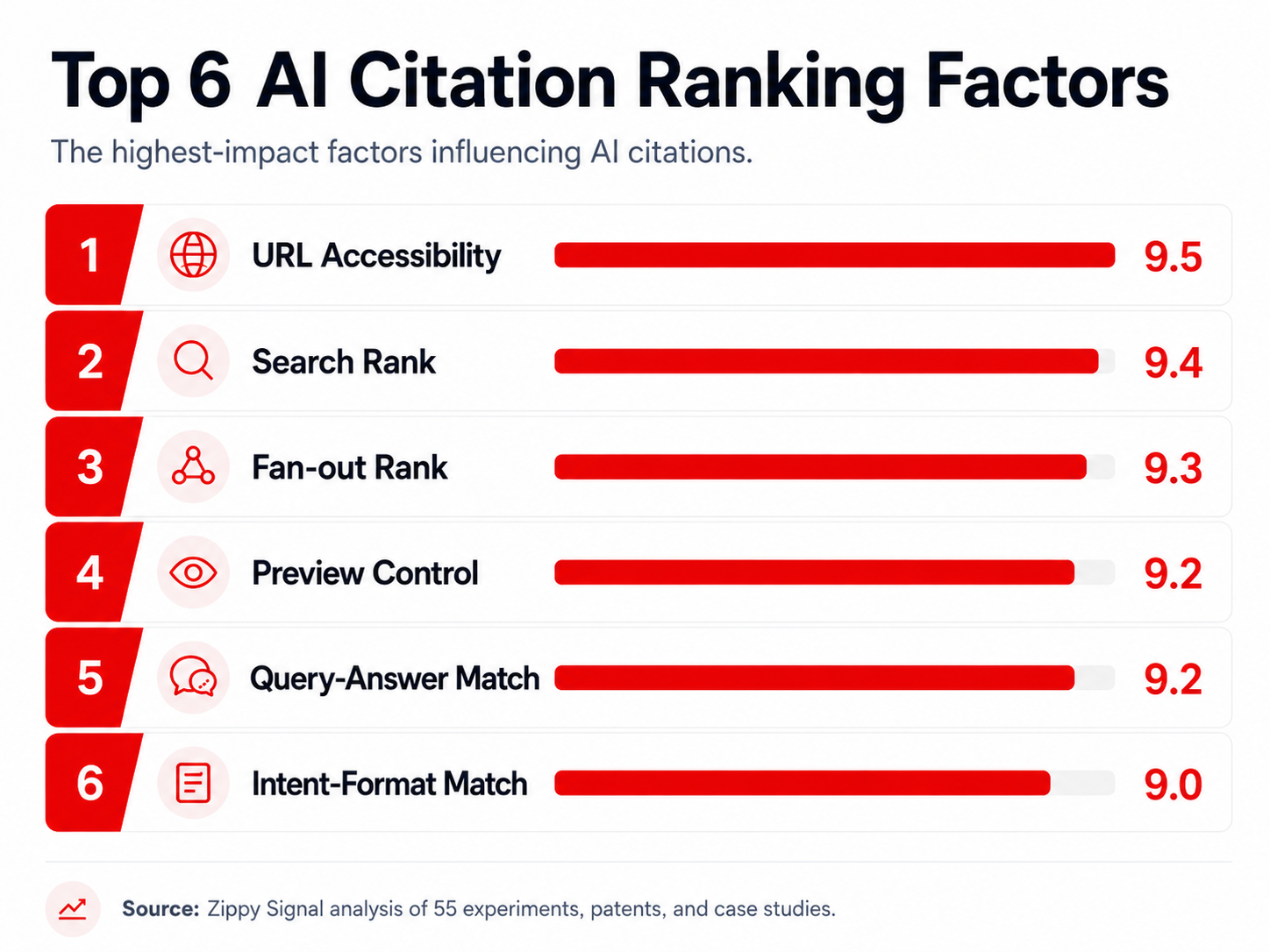
Credit for the original research analysis goes to Cryus Shepard. His analysis covers many more factors, I limited this article to the top 6 that scored >9.
Factor 1: URL Accessibility
Let’s start with the first factor in the list: URL accessibility.
At a very basic level, URL accessibility means making sure search engine crawlers and AI systems can find, read and understand the pages on your site. There are four main elements to think about.
1. Crawlability
Search bots need to be able to discover your URLs through clean site architecture, proper internal linking and XML sitemaps. If your content is hard for a crawler to find, it is much less likely to appear in search results or be understood by AI systems.
2. Readable structure
A strong URL uses descriptive words rather than random numbers, symbols or character strings. A URL like /seo-best-practices gives both users and search engines a clearer signal than something like /page?id=12345.
3. Hierarchy
The URL path should reflect how the page is organized within your site. This helps search engines understand the relationship between pages and gives users a clearer sense of where they are.
4. Protocol and domain security
Using HTTPS and a clean, easy-to-read domain matters. Security, clarity and trust all play a role in how people and search engines interpret your site.
So why does URL accessibility matter for SEO and GEO?
First, it helps search engines understand your content. Search bots are essentially reading your site through code. A clean URL gives them immediate context about the topic of the page.
Second, it can improve click-through rates. URLs are part of the first impression users see in search results. A concise, descriptive link looks more trustworthy and is easier to understand.
Third, it helps prevent technical issues. Accessible URLs reduce the risk of broken links, redirect loops, confusing query parameters and other problems that can interfere with indexing.
The best practices are fairly simple and should be 101 for any site manager to handle: keep URLs short and descriptive, use clear words rather than random strings, avoid messy parameters where possible, make sure important pages can be crawled, and maintain a clean site structure.
Without overstating the obvious, if your content cannot be found, read or understood, it has a much lower chance of being surfaced by either search engines or generative answer engines.
“The future of content will not be human or AI. It will be human-led, AI-supported and strategy-driven.”
Factor 2: Search Ranking

Traditional rankings still matter because they are often a signal that your brand has earned the right to speak. E-E-A-T is how that right gets demonstrated.
Next, let’s look at search ranking.
As the name suggests, this is where your content ranks for a specific search on a traditional search engine results page. The higher the position, ideally number one, the better the chance your content has of being cited in a generative answer.
Sounds simple, right?
In theory, it is. In practice, this has been the holy grail for SEOs for more than 20 years.
There are many ranking factors that Google uses to determine where a page appears in search results. Depending on who you ask, the number is often estimated to be somewhere between 150 and 200. But for non-technical marketers, a helpful place to start is with the acronym Google uses: E-E-A-T.
That stands for Experience, Expertise, Authority and Trust.
In simple terms, Google wants to understand whether your brand has a credible right, and permission from the audience, to be talking about a particular subject.
Can your brand demonstrate genuine expertise in the topic? Does your site have authority in that area? Have you organized your content clearly enough to signal that you are relevant in that space? Or is your site a mash-up of dozens of disconnected topics, with no clear editorial focus?
Ideally, your answer is the former.
The same applies to the other parts of E-E-A-T. Can you point to actual experience working in that space? Do you have real examples, case studies, research, credentials, expert contributors or customer stories? Do other credible organizations and users mention your brand, link back to your site or reference you when discussing those subjects?
This is where SEO starts to overlap with brand, content strategy and reputation.
You are not just trying to rank for a keyword. You are trying to build evidence that your brand has a legitimate role in the conversation. In publishing terms, this is what we might call “right to voice.” Why should this brand be trusted on this subject? What gives it the authority to speak?
That matters for SEO, and it increasingly matters for GEO too. If generative engines are looking for reliable sources to cite, summarize or draw from, then brands need to make their expertise, experience, authority and trust as clear as possible.
Factor 3: Fan-Out Queries
The third important topic is something called a “fan-out query.”
It’s a new term, but not really a new practice.
In simple terms, a fan-out query is what an LLM may do to better understand a user’s question. Instead of treating the original question as one narrow search, it breaks it into a wider set of related questions so it can build a more complete answer.
Typically, that process happens in three stages.
1. Decomposition
The AI breaks a broad question into smaller subtopics or related questions.
2. Parallel retrieval
It searches for answers to those related questions across the web, its index or other available sources.
3. Synthesis
It pulls the findings together into one fuller, more contextual answer.
If this sounds familiar, it should.
Good SEO practice has worked in a similar way for years. Marketers and publishers have long built content clusters around important search terms to establish topical authority. The idea is that you do not just create one isolated page on a subject. You build a connected body of content that answers the core question, the related questions and the follow-up questions a user is likely to ask with strong on page internal linking and navigation between them.
That helps demonstrate expertise, which connects directly back to the E-E-A-T principle.
Fan-out queries and content clustering are not exactly the same thing, but they are closely related. You could think of them as two sides of the same coin. One is how an AI system may explore a topic. The other is how a brand can organize content to show it has real depth and authority on that topic.
A good example might be a consumer asking:
How does a 401(k) work?
A fan-out query might include related searches such as:
What is a 401(k)?
How does a 401(k) retirement plan work?
Who is eligible for a 401(k)?
How much can you contribute to a 401(k)?
What is an employer 401(k) match?
What is the difference between a traditional 401(k) and a Roth 401(k)?
What happens to your 401(k) when you leave your job?
For a financial services brand, the lesson is fairly straightforward. You should not only answer the main question. You should also anticipate the surrounding questions and organize your content in a way that makes those answers easy to find.
Most content teams should already be looking at keyword clusters, related searches and user intent when planning content. So, again, this should not feel completely new. It is another example of the same broader point: good SEO practice is increasingly good GEO practice too.
Factor 4: Preview Controls
The next important area is the use of preview controls.
In Answer Engine Optimization, and also traditional SEO, preview controls are search engine directives that dictate how much of your webpage’s content is allowed to appear in search engine listings, including AI Overviews and AI Mode summaries.
Because AEO and GEO rely heavily on being cited by or surfaced in AI formats, how you use these controls can directly impact your AI visibility.
The most common preview controls used by site owners include:
nosnippet
This is the most restrictive tag. It prevents any text, video or image preview from showing, which heavily reduces the chances of an AI engine summarizing or citing your page.
max-snippet
This allows you to cap the maximum number of characters Google can pull from your page. Setting a very low limit may prevent an AI engine from generating a complete summary of your page.
data-nosnippet
This is an HTML attribute that prevents specific sections or text blocks on your page from appearing in snippets or AI summaries. This allows you to keep the rest of your content searchable and AI-eligible.
noindex
This tells the search engine not to include the page in its index at all. If a page is not indexed, it cannot be surfaced in AI features.
So why do preview controls matter for AEO and GEO?
If you want your brand to be cited by large language models and search assistants, you need to be careful about using overly broad preview controls or blocking AI crawlers altogether.
That does not mean everything has to be freely available. If you have proprietary data, expert guidance, tools, research or paywalled content that you want users to click through to access, you can still use these controls selectively. The point is to make a deliberate choice about what you want AI systems to see, summarize and cite, and what you want to protect.
Again, much of this sits within good technical SEO practice. For many brands, it should already be part of how the site is managed.
But there is a small difference between traditional SEO and GEO.
With traditional SEO, you optimize title tags, meta descriptions, headlines and organic URLs to improve click-through rates from the search results page. You are trying to make your result attractive enough that someone chooses to click.
With GEO, the goal is slightly different. You are trying to make your content easy for generative systems to understand, trust and cite. That means paying attention to in-text citations, concise facts, structured Q&A content, schema, crawl permissions, preview controls and opt-in or opt-out settings for AI crawlers.
In simple terms, SEO is largely about earning the click. GEO is increasingly about earning the citation.
So, the two are closely connected, but they are not exactly the same.
Factor 5: Query-Answer Match
Another important area is query-answer match.
This is another one of those areas that feels 90% similar across SEO and GEO, with a subtle but important difference.
In Generative Engine Optimization, a query-answer match refers to how effectively a webpage’s content directly satisfies the specific information being requested by a user, or by an AI agent’s underlying search.
In publishing terms, we might think of this as audience-first thinking. Does this content actually provide the answer to the user’s question?
There are three core pillars of query-answer match.
1. Semantic relevance
The page must deeply cover the subject matter and intent behind the query, rather than simply stuffing targeted keywords into a sentence.
2. Conciseness and formatting
AI systems frequently pull information into bulleted lists, direct answers or concise definitions. Using structured formats, such as direct answers at the beginning of a section, makes it easier for an LLM to parse and extract your text.
3. Corroboration and authority
Search platforms cross-reference answers across multiple sites. A page is much more likely to be matched and cited if it includes verifiable data, statistics, expert quotes, credible sources or other proof points.
The difference between query-answer match and traditional SEO is important.
Traditional SEO optimizes for keywords, backlinks and domain authority so that a page can rank in the top search results.
GEO query-answer match optimizes for intent and information synthesis. The goal is to provide such a clear, comprehensive and well-structured answer that the AI engine can confidently recommend your brand and link to your site as a source.
Moving forward, brands need to answer questions in ways that work for humans and machines.
That is where page formatting also matters.
For traditional SEO, good formatting helps users and search engines understand what a page is about. For GEO, it may matter even more because AI systems are looking for clear, structured information they can understand, summarize and cite.
That means content should be organized with clear headings, direct answers, short sections, bullet points, comparison tables and Q&A-style formatting where appropriate. A strong page should not make the reader, or the machine, work too hard to understand the main point.
If a page answers a question, answer it clearly. If it explains a process, break it into steps. If it compares two things, use a table. If it defines a concept, make the definition easy to find.
This is not about writing for robots instead of people. It is about making useful content easier for both people and machines to understand.
Factor 6: Intent-Format Match
Finally, there is something called intent-format match.
That sounds a bit technical, but the idea is simple. The format of your content should match the intent behind the user’s question.
If someone asks, “What is a 401(k)?”, they probably need a clear definition.
If they ask, “How does a 401(k) work?”, they may need a step-by-step explanation.
If they ask, “Traditional 401(k) vs. Roth 401(k), which is better?”, they probably need a comparison.
If they ask, “How much can I contribute to a 401(k)?”, they need a specific fact, ideally with the year clearly stated.
In other words, not every query should be answered in the same format. Some questions need a short answer. Some need a list. Some need a table. Some need a how-to guide. Some need a calculator, checklist, FAQ or decision tree.
This matters because generative systems are trying to match the user’s intent with the most useful answer format. If your content is buried in long paragraphs when the user needs a simple comparison, it may be less useful. If your page provides a clear answer, a supporting explanation and the right structure, it is easier for both people and AI systems to understand and reuse.
Again, this connects back to the broader point: good SEO practice is good GEO practice. The best content does not just include the right keywords. It understands the question, answers it clearly and presents the information in the format most useful to the person asking.
A Final Note on Third-Party Mentions and Earned Media
One area I’m really surprised did not make the top six, or even number one, is third-party citations. Or, to use a more familiar term, earned media.
I personally believe third-party mentions may become the GEO equivalent of backlinks in SEO.
They are hard to earn. They are outside of your direct control. And because of that, they may provide one of the biggest signals of authority.
In traditional SEO, marketers often focused on backlinks. Who is linking to your site? How authoritative are those links? What does that signal to Google?
It is worth remembering that Google’s original name was BackRub, which itself was a nod to the importance of backlinks. The idea was that if other sites were “rubbing your back” by linking to you, that was a signal that your site had authority on that topic.
For GEO, the signal appears to be broader.
LLMs and AI search systems are not only looking at links. They are also looking at where your brand is mentioned, who mentions it, what topics you are associated with and whether those mentions come from credible third-party sources.
That means earned media, analyst mentions, industry coverage, expert roundups, reviews, customer discussions and credible citations may all play a role in shaping how AI systems understand your brand.
This is where brand, PR, content strategy and SEO start to overlap. It is not enough for your own website to say you are an authority on a subject. The wider web needs to support that claim.
In simple terms, backlinks still matter. But in GEO, brand mentions may matter more. The goal is to build enough credible evidence around your brand that AI systems can understand not only what you do, but why you should be trusted on that subject.
Final Thought
Apologies for the length of this article, but I hope it helps demystify what is going on with GEO, how it is similar to SEO and where it differs.
The main takeaway is fairly simple: GEO is not a total move away from SEO.
A lot of the work still comes back to the same fundamentals. Make your content easy to find. Make it easy to understand. Build authority around the topics you want to own. Answer real questions clearly. Structure your pages so people and machines can use them. And create enough credible evidence across the wider web that your brand has a legitimate right to voice.
Good SEO practice is not going away.
It is becoming the foundation for good GEO practice too.
“AI may change how content is made and distributed, but humans still need to decide what is worth saying, why it matters and who it is for.”