

AI Is Everywhere. That’s Why Human Creativity Matters More Than Ever (Takeaways From Fast Company’s Most Innovative Companies Summit.)
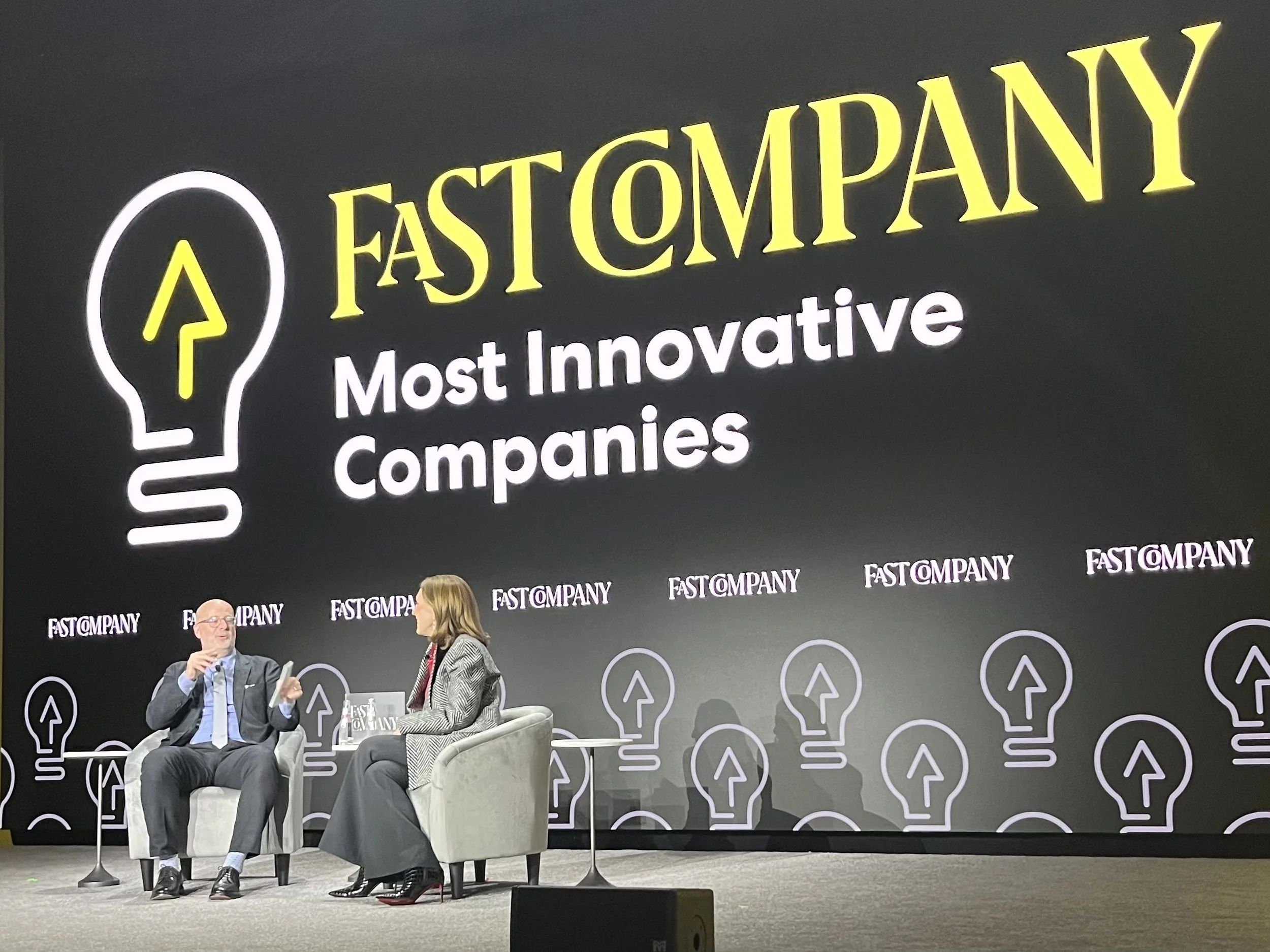
Ruth Porat, President and Chief Investment Officer, Alphabet and Google. Moderated by Brendan Vaughan, Editor-in-Chief, Fast Company
My main takeaway from a really great day at Fast Company’s Most Innovative Companies Summit: AI was everywhere in the conversation, as you’d expect. But the more interesting subtext was not just the speed of AI adoption. It was the sense of tension that now exists around it.
There is clearly excitement, and from lots of places. Ruth Porat from Google talked about AI as a major platform shift. Others talked about redesigned workflows. Others talked about agents, search and productivity increases. But there was also a more cautious thread running through the day: AI fatigue, trust, job anxiety, generic “beige” content and the need to protect the things that still make us human.
The main thread of the conversations was about what AI can make possible, but also what it might flatten, replace or make less valuable if businesses use it without deploying enough human judgment.
Steve Huffman from Reddit had one of the best lines I heard all day: “There’s no artificial intelligence without actual intelligence.” AI is great at summarizing, synthesizing but it’s still trying hard to generate human-level content.
AI may change how content is produced, found and distributed. But it does not remove the need for a really good content strategy. It actually makes the need for strategy more important. The brands that win in this new environment will not simply produce more content faster.
They will be clearer about what they stand for, more disciplined about what they publish, and more intentional about how they show up across search, social, AI answers and human conversations.
The AI conversation is becoming more practical
One of the useful things about the summit was that the AI discussion was not only theoretical. It kept coming back to work, workflows and what companies actually do with the technology.
In one session, the talk was of putting agents at the center of workflows and reducing the number of steps required to get work into market. That is real operational change, not just experimentation. I heard it described like this, “We’re not here to automate a job, because a task is not a job. We’re here to automate tasks, not jobs.”
The anxiety around AI is not abstract. It is about work, skills, value and their own sense of personal identity. If AI can take over a growing number of tasks, people naturally start to ask what is left for them to do.
The best answer I heard was not that humans will always be better at everything. That is obviously not true. The better answer is that humans need to be clearer about where they add value and where the machines do.
Context. Judgment. Taste. Lived experience. Creativity. Empathy. Strategic thinking. The ability to know what matters, not just what can be generated. That’s where people really add value.
The backlash is not anti-AI. It is anti-generic.
Huffman described Reddit as a place built around communities, voting and user empowerment. Users create the communities. Users write the rules. Users create the content. Reddit’s value is not just information. It is human context. It is people talking to other people about things they are interested in and really care about.
Huffman made clear that Reddit wants to remain a human space. He talked about the gray area of AI-written posts: there may be a human behind the idea or the prompt, but the output often feels like a bot and the writing “sucks”. More importantly, he said Reddit users are already starting to reject and vote down that kind of content.
There was obviously already too much generic badly written content before AI came along. AI just makes it easier to produce more of it. More blog posts. More summaries. More social captions. More thought leadership that sounds like thought leadership but does not actually say very much. In other words, more “beige content.”
In an environment where everyone has access to the same tools, that kind of content becomes even less useful. If AI makes it easier for every company to sound competent, then competence is no longer enough.
Specificity became one of the strongest themes of the day
Sev Ohanian, founder of Proximity Media when talking about his own early filmmaking experience, he made the point that a story can be extremely specific to one culture and still connect with people across other cultures. Specificity is not the enemy of scale. Often, it is how scale happens. The more generic something is, the less reason people have to care about it. The more specific it is, the more likely it is to feel true.
Rich Bloom, GM, Creator Programs. from Tubi talked about the decline of monoculture and the importance of serving fandoms and niche audiences. Reddit talked about communities built around real interests and real conversations. Proximity Media talked about culturally specific stories that can still travel widely. Even The Onion session, in its own very different way, was about voice, editorial conviction and knowing exactly what kind of publication you are.
People do not connect with content because it is broad. They connect with it because it feels relevant, specific, useful, entertaining, trusted or true.
A lot of companies still approach content as if broadness is the goal. They strip out the sharp edges out of concern they don’t offend anybody, internally or externally. They avoid saying anything too specific. They write for “audiences” rather than actual people with real problems, questions and motivations. AI can do broad. AI can do generic. AI can do competent.
Brands need something more: a clearer point of view, a better understanding of audience needs, a stronger editorial filter and a sharper sense of where they are credible and where they are not.
That is what real content strategy is.
Big thanks to my friend Damian at Fast Company for the invite to the event.