

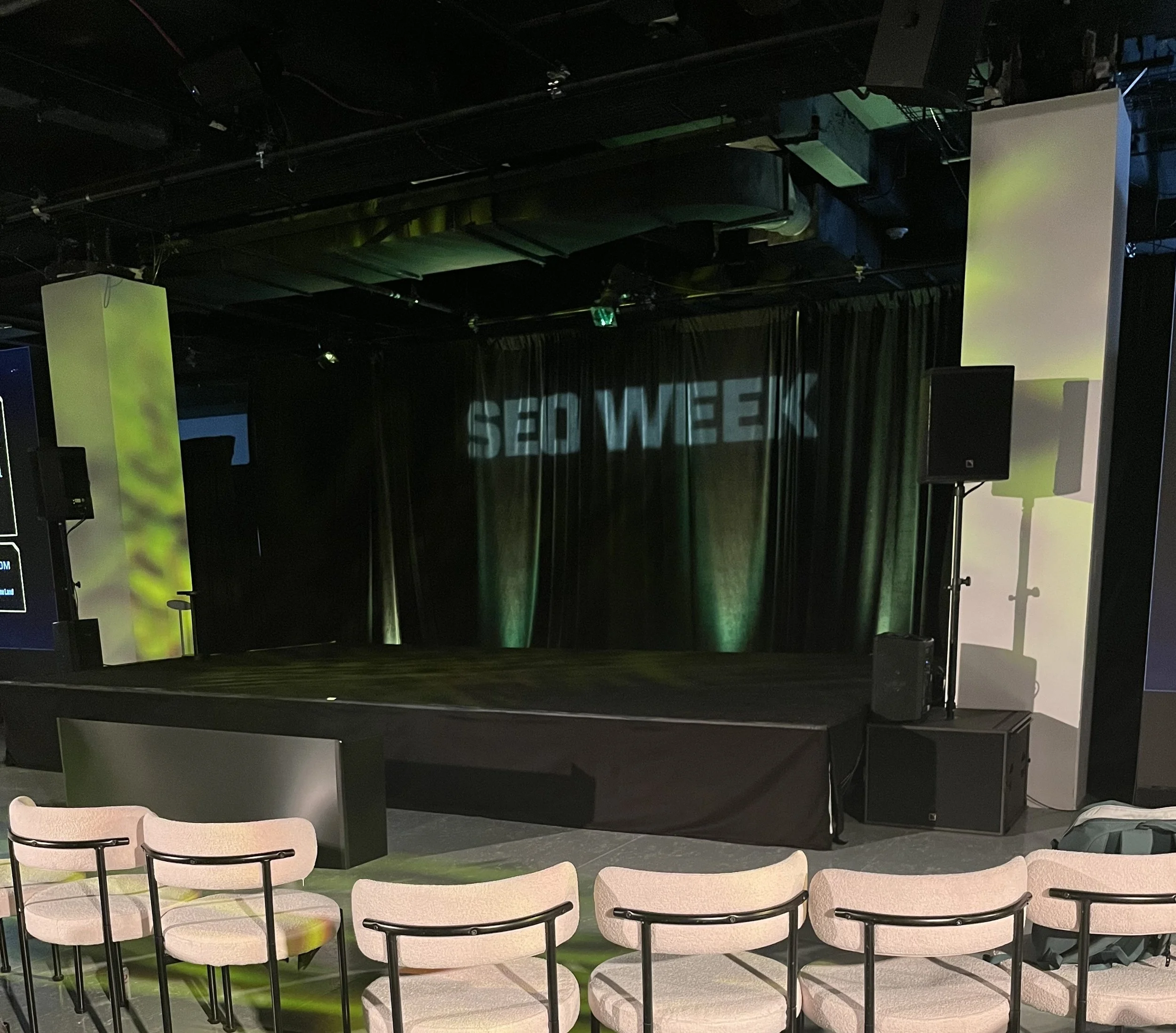
Welcome to SEO Week | April 27th to 30th I New York City
Across the week, the discussion moved from the mechanics of AI search to content strategy, distribution, measurement and business outcomes. By the final day, the focus shifted to: what happens when AI systems stop simply answering questions and start taking action on behalf of users?
That is where agents come in. Crystal Carter put it in these terms: “agents do stuff.” They fill out forms, compare products, enter payment details, check availability, rebook travel, manage tasks and complete multi-step errands. In other words, they do the work users often do not want to do themselves.
That has major implications for brands. If agents are increasingly acting as intermediaries between people and businesses, then the next user of a website may not be a human scrolling through a page. It may be an AI system trying to understand whether a brand can be safely, confidently and efficiently recommended. That means websites have to work for people, search engines AND agentic users at the same time.
Crystal added that “the web is being rebuilt for agentic users.” She described agents as using the web in a way that is “distinct from humans, right? Parallel but distinct.” That line captures the new challenge well. Brands still need human-facing content, but they also need information that is structured, accessible, comparable, transactable and easy for agents to validate.
Her point about the funnel was especially important. In the traditional model, marketers moved people from awareness to consideration to evaluation and purchase. Google later popularized the idea of the messy middle, where users loop between exploration and evaluation. But Crystal argued that the messy middle now has “new mediators.” Agents can take over parts of consideration and evaluation before a person ever reaches the brand. The user may only become aware of the brand when they are close to purchase and need to validate the recommendation.
That should change how brands think about content strategy. It is not enough to explain what you do in a way that a person can eventually understand. Brands need to make claims easy to verify, comparisons easy to make, product details easy to access and trust signals easy for both people and systems to interpret. If an agent needs evidence to recommend your product or service, that evidence needs to exist in a format the agent can use.
Ryan Jones added another useful point by challenging the idea that the funnel is still a funnel at all. He called it a “pinball machine,” because people now “bounce in from everywhere.” That feels like a more accurate description of discovery today. A customer may encounter a brand through Google, AI Overviews, ChatGPT, social, YouTube, a review site, an influencer, a CRM touchpoint, a recommendation engine or increasingly an agent that is acting on their behalf.
That creates a measurement challenge. If the journey is fragmented, then clicks alone cannot tell the whole story. Ryan put it like this: “clicks are vanity metrics,” and marketers need to “go beyond clicks.” That does not mean clicks are useless. They still help diagnose performance and understand certain user behaviors. But they are no longer enough as a boardroom measure of value.
The question is now how SEO, GEO and content strategy influence the broader journey. Ryan argued that the work affects share of voice, paid search quality, referral traffic, lifetime customer value, CRM, conversion rates and brand awareness. In other words, the value of search and content extends well beyond the click from a blue link. That is especially true in an AI environment where answers, citations and recommendations may shape decisions before a user visits a brand’s site.
Paul Shapiro’s session added an important systems perspective. His point was that agents are not just models. They are models running inside “harnesses,” which include memory, tools, permissions, file systems, loops and the broader environment that allows the model to do work. That matters because brands are not optimizing only for a language model in isolation. They are increasingly optimizing for systems that can reason, retrieve, compare, execute and transact.
That distinction is important. A brand might appear in an AI answer, but the agentic future raises a different question: can the system act on the information it finds? Can it compare the brand correctly? Can it understand the offer? Can it complete a transaction? Can it validate the recommendation with evidence? Can it avoid hallucinating or misrepresenting what the brand does? These are not just SEO questions. They are content, product, technology, data and trust questions.
Ilana Gershteyn’s session offered a counterbalance to all of this change. In a volatile environment, teams can overreact when traffic drops or rankings shift. Her framework for working through a Google drop focused on discipline, diagnosis and the internal systems that shape decision-making. She reminded the audience that when performance changes, the first thing many teams inspect is rankings, logs, site speed or content quality, but they often miss “the one that’s running between your ears.”
That point matters because the speed of change in search can create panic. Teams can rush to blame AI Overviews, delete content, reverse changes, chase vanity metrics or overfit a theory before they understand the real issue. In the agentic era, calm diagnosis becomes even more important. Brands need a clear process for understanding what changed, what matters and what action is actually required.
For brands, the work ahead is not just publishing more content, chasing more rankings or collecting more AI citations. The work is building a connected visibility strategy that helps people, search engines and AI agents understand who the brand is, what it offers, why it should be trusted and when it should be recommended.
SEO Week is iPullRank’s flagship search conference in New York City, bringing together senior SEO professionals, marketers, technologists and business leaders to explore how AI, search, content strategy and information retrieval are changing the way brands are discovered and evaluated online. The 2026 event runs April 27–30 in NYC, with four days of programming focused on modern search and AI-driven discovery.