

SEO Week Day 3: Visibility Is Not the Same as Value
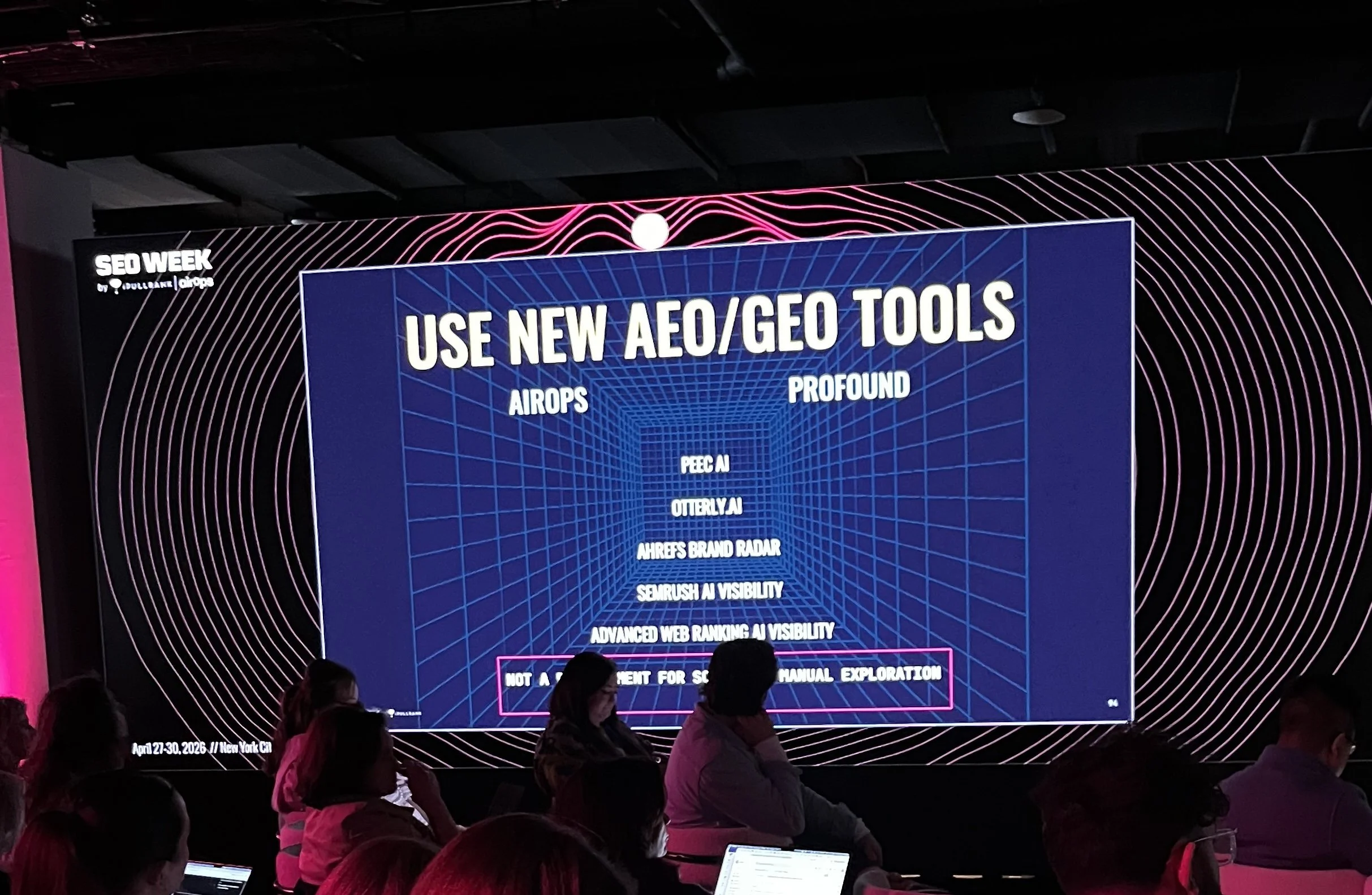
Welcome to SEO Week | April 27th to 30th I New York City
Day 3 of SEO Week brought the things back to: what is all of this actually doing for the business?
Across the first two days, a lot of the discussion focused on AI search, retrieval, technical readiness, content quality, distribution and the changing mechanics of discovery. Day 3 built on that, but added more of a commercial lens to the discussions. It was not just about whether a brand shows up in Google, ChatGPT, AI Overviews, Google Discover or any other surface. It was about whether showing up actually creates value for the business.
That distinction matters because I think that marketers have spent years training clients and stakeholders to care about visibility. We told them rankings really do matter. Impressions matter. Clicks matter. Traffic matters. Backlinks matter. And they do. But as the search and AI landscape changes, those metrics are becoming more volatile, less complete and harder to connect directly to business outcomes.
One of the strongest sessions came from Brie Moreau, who challenged the way SEO and marketing have historically been sold. His argument was not that industry metrics are useless. It was that they have often been sold incorrectly. Rankings, traffic, impressions and visibility should be used to guide strategy, but they should not be mistaken for the outcome. The stronger question is what happens after someone sees the result, clicks the link or arrives on the site.
That point came through in one of his clearest lines: “there’s a difference between showing up and giving somebody the right information at the right time, in the right way, so that they can make the right decision.” That is a much better definition of what SEO and content strategy should be doing now. The goal is not simply presence, the goals must be more orientated towards influence, usefulness and action.
He also made the case that SEOs and content teams need to own more of the business outcome. A blog post that ranks but does not help anyone take the next step is not necessarily a win. A traffic decline that still comes with higher purchases or stronger conversion may not be a loss. A PR mention, a review site, a Trustpilot page, a G2 listing, a Google Business Profile or an AI referral may all play a role in the journey, but only if those touchpoints are properly tracked and understood. His message was to stop selling traffic and visibility as the final value, and start connecting the work to outcomes.
Ray Martinez’s session made that idea about showing business outcomes, feel very practical. In higher education, he explained, the goal is not simply traffic. The main objective is enrollment at the lower funnel. His team had built a strong traditional SEO foundation around technical SEO, accessibility, content strategy, link building, organic social and digital PR. But when visibility dropped for one program, the issue was not one simple ranking problem. It involved search, fetch, AI visibility and the way LLMs were reading the page. A semantic HTML issue meant AI systems were stopping after the first two sentences and failing to summarize the content properly.
AI visibility is not just about producing more content or chasing more citations. It depends on whether systems can access, read and interpret your content correctly. If a page is technically available but semantically confusing, a brand can lose control of how its information is understood and repeated. In Martinez’s example, that meant the brand’s content could be displaced by someone else’s better interpretation of the same information.
Martinez also made an important point about how SEO and GEO fit together. Good traditional SEO may get a brand much of the way there, but there is another layer that works differently. His team responded by bringing SEO, GEO, organic social, digital PR and content teams closer together, then using semantic scoring, entity gap analysis, multimodal content and digital PR to improve results. The most important result was not just traffic. Even with organic traffic declining, they were still driving leads and enrollments because they focused on less content and more of the right type of content.
That phrase, “less content and more of the right type of content,” feels like one of the most used phrases at the whole event. It connects directly to the broader theme of the week: Brands are not short on content. They are short, however, on connected, useful, strategically structured content that answers real audience needs, supports AI interpretation and moves people toward a decision.
Brie’s session added a more technical layer to the same theme. His talk also focused on embeddings, off-site signals, semantic backlinks and how brands are represented within broader information systems. One of his key points was that off-site authority is not just about building links in the old sense. It is about where those links sit in the semantic landscape, whether they come from pages that are relevant to the topic, and whether they help reinforce the right meaning around a brand.
Moreau also argued that ranking in Google does not automatically mean ranking in LLMs, citing research that showed limited overlap between Google and ChatGPT. That is important because it reinforces the idea that AI visibility cannot be treated as a simple extension of traditional SEO. Brands need to understand where their information lives, how it is connected, and whether the broader web is reinforcing or weakening the story they want AI systems to understand.
John Shehata’s session on Google Discover suggested that it can drive significant traffic, but he warned that it is volatile, unpredictable and supplemental. His point was not to ignore it, but also not to become dependent on it. Discover can support a broader audience strategy, but it is not a strategy by itself.
Shehata also explained that Discover is shaped by ingestion, sorting, eligibility, interest matching, feed assembly and feedback signals. It is not simply a matter of writing a great headline and waiting for traffic. Entities, topics, images, user interests and content quality all play a role. He also talked about two strategic approaches: repeating what is already working and identifying adjacent trends that connect a brand’s area of expertise to what audiences are already paying attention to.
For brands, that is a useful way to think about distribution more broadly. The opportunity is not to chase every trend. It is to understand where a brand has permission to participate, where it has expertise and how it can connect its content to audience interest without losing relevance.
My biggest takeaway from Day 3 is that SEO is becoming both broader and more accountable. It now touches technical infrastructure, content strategy, analytics, PR, social, structured data, AI visibility, brand positioning and the full customer journey. But that does not mean the answer is more activity. The answer is more strategic alignment.
SEO Week is iPullRank’s flagship search conference in New York City, bringing together senior SEO professionals, marketers, technologists and business leaders to explore how AI, search, content strategy and information retrieval are changing the way brands are discovered and evaluated online. The 2026 event runs April 27–30 in NYC, with four days of programming focused on modern search and AI-driven discovery.