

SEO Week Day 1: AI Search Is Changing What It Means to Be Visible
Welcome to SEO Week | April 27th to 30th I New York City
Day 1 of SEO Week in NYC. SEO is no longer just about where a brand ranks. It is about whether a brand’s content can be understood, retrieved, trusted, cited and used by AI systems. That is a much more complex challenge than traditional search, and it explains why so much of the conversation today felt so deeply technical. But underneath the language of embeddings, retrieval, context windows, citations and query fan-out, there was a message for brands: content strategy now has to work for people, search engines and AI systems all at the same time.
Mike King of iPullRank framed one of the biggest shifts of the day when he said that “search is becoming invisible.” We still tend to think of search as someone typing a query into a box, but search now powers much more of the internet experience. It sits behind maps, email, chatbots, agents and the broader systems that filter information for users in the background. That matters because discovery is no longer confined to a search results page. It is increasingly happening inside AI-assisted experiences where the user may never see the full set of sources, pages or signals that shaped the answer.
That shift raises a bigger question for brands. If search is becoming less visible to the user, how does a brand make itself more visible to the “system”? Andrea Volpini’s session helped answer that by focusing on the move from pages to entities and from structured data to what he described as the “memory layer” for AI agents. His point was that brands need to make it easier for AI systems to connect products, authors, locations, claims and evidence. In his words, “the real advantage is not writing more content,” but creating more condensed, connected data structures that help models provide better answers.
That is a major content strategy shift. For years, brands have thought about content largely in terms of pages, keywords and rankings. In an AI search environment, the question becomes whether the brand has created enough clear, connected evidence for a model to reason with. It is not enough to have content sitting on a site if the system cannot understand how it all fits together. The opportunity must be to build content ecosystems that are coherent, structured and authoritative enough to support the answers AI systems are generating.
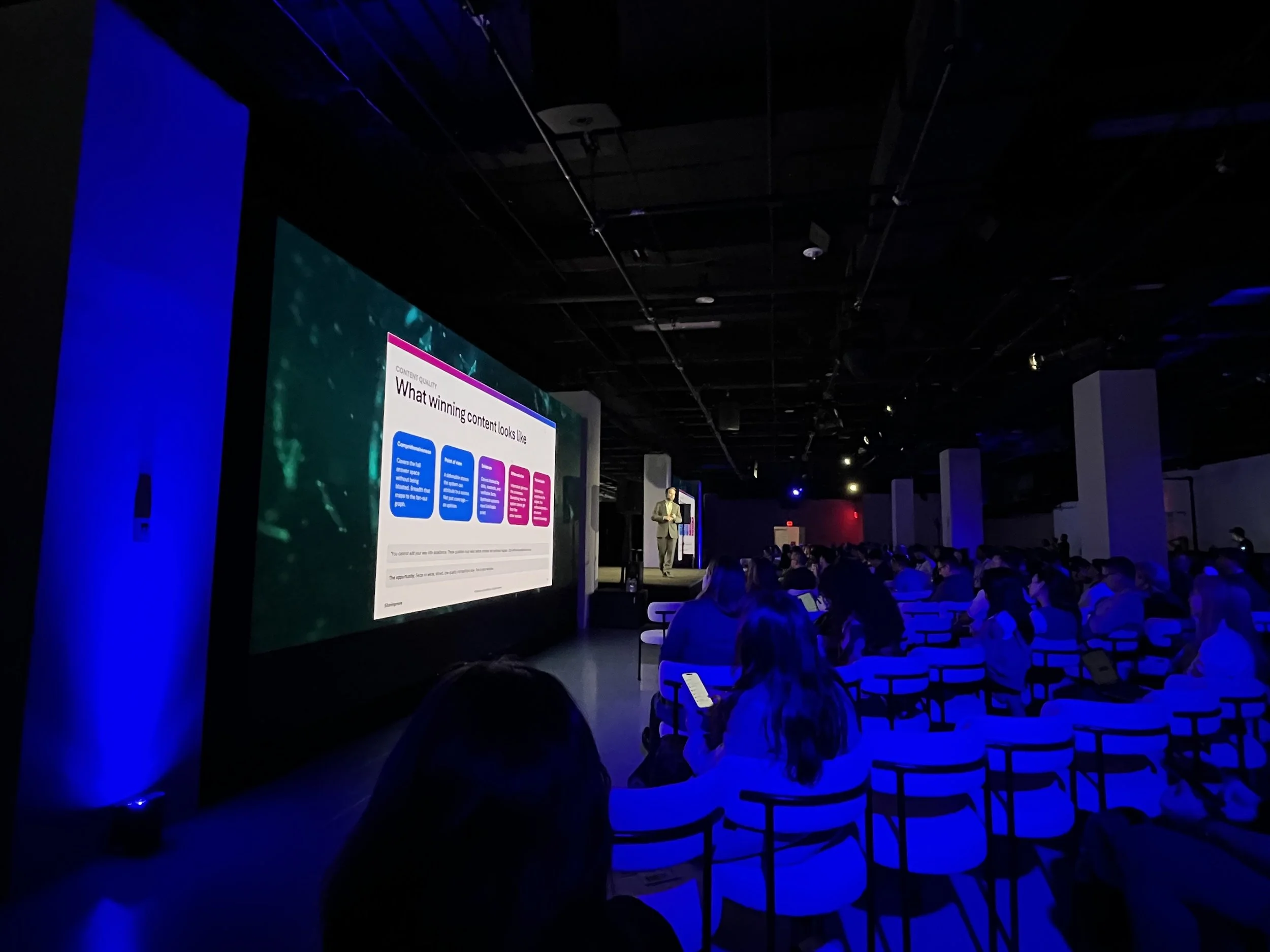
A Day 1 recap from SEO Week NYC on how AI search is reshaping SEO, content strategy, brand visibility, measurement and what it means to be understood by both people and machines.
Measurement was another major theme of the day. Dale Bertrand made a great point when he said that “traffic growth is now divorced from business growth.” That line should be a wake-up call for any brand still measuring content primarily through sessions and clicks. AI search is breaking attribution, creating more zero-click behavior and sending some AI-influenced traffic into places like the direct traffic bucket in GA4. The result is that many of the metrics marketers have relied on to prove value now have major blind spots.
That does not mean measurement becomes less important. It means it has to evolve. Brands need to understand how content influences perception, demand, preference and pipeline, even when the path is harder to trace. A piece of content may not deliver the traffic it once did, but it may still shape what AI systems say about a brand, how customers evaluate options and whether the brand is included in the consideration set. For content teams, the challenge is to move beyond reporting what is easy to count and start connecting content to the outcomes that matter.
Mike King also pushed the industry to rethink the tools and models it is using. His argument was that much of SEO software still reflects an older, more lexical view of search, while AI search increasingly depends on semantics, vector embeddings and the relationships between content, queries and entities. He challenged the industry to stop treating this as “just SEO” and recognize that there are meaningful technical differences between traditional search and AI-driven discovery.
That point matters because brands cannot solve a new visibility problem with only old reporting frameworks. If AI systems are evaluating content through retrieval, embeddings, semantic similarity and evidence, then content teams need a clearer view of how their content is represented in that environment. They need to understand gaps, misalignment, semantic drift and whether their content actually supports the journeys and questions customers are bringing to AI platforms. This is not just a technical issue. It is a strategic one.
Jeff Coyle brought the discussion back to content strategy, his point was that topic clusters are becoming retrieval and coverage maps. That is a powerful way to think about the future of content. Topic clusters are no longer just an SEO architecture for internal linking. They are a way of showing that a brand has covered the full set of questions, subtopics and decision points around a subject. When done well, they help both people and AI systems understand what a brand knows, what it can credibly speak to and where it has depth.
Coyle also made the risk of publishing weak AI slop content very clear. Publishing large volumes of disconnected, low-value content does not create authority. In many cases, it can make the problem worse by adding noise to an already fragmented content ecosystem. If the product section does not connect to the blog, the help center is outdated, internal linking is broken and old content is never refreshed, adding more AI-generated content will not fix the strategy. It will expose the lack of one.
My biggest takeaway from Day 1 is that AI search is forcing content strategy to become more connected, more technical and more accountable. Brands can no longer think about SEO, content and AI visibility as separate workstreams. They are now part of the same discovery system. The question is not just whether content ranks, but whether it is structured clearly enough to be retrieved, authoritative enough to be trusted and useful enough to influence the answer.
That is also where I see the opportunity for Content Connection. Many brands are not short on content. They are short on a strategy that connects content to search, AI visibility, audience needs and business outcomes. In this new environment, the winning brands will not be the ones that simply publish more. They will be the ones that know what they want to be known for, build content around real audience questions, structure it so machines can understand it and measure its value beyond the click.
SEO Week is iPullRank’s flagship search conference in New York City, bringing together senior SEO professionals, marketers, technologists and business leaders to explore how AI, search, content strategy and information retrieval are changing the way brands are discovered and evaluated online. The 2026 event runs April 27–30 in NYC, with four days of programming focused on modern search and AI-driven discovery.